
One of the primary reasons for the notable shifts in the field of digital marketing throughout time is the continuous evolution of Google algorithms. In order to improve user experience and provide the most relevant, dependable, and excellent search results, Google regularly updates its search algorithm. It is crucial for website owners, bloggers, companies, and Digital Marketing Freelancer in Dubai to comprehend these developments. One algorithm change can result in a sudden drop in ranks or an overnight boost in website visitors. Google has made a number of significant changes since the beginning of SEO that have altered how websites appear in search results.
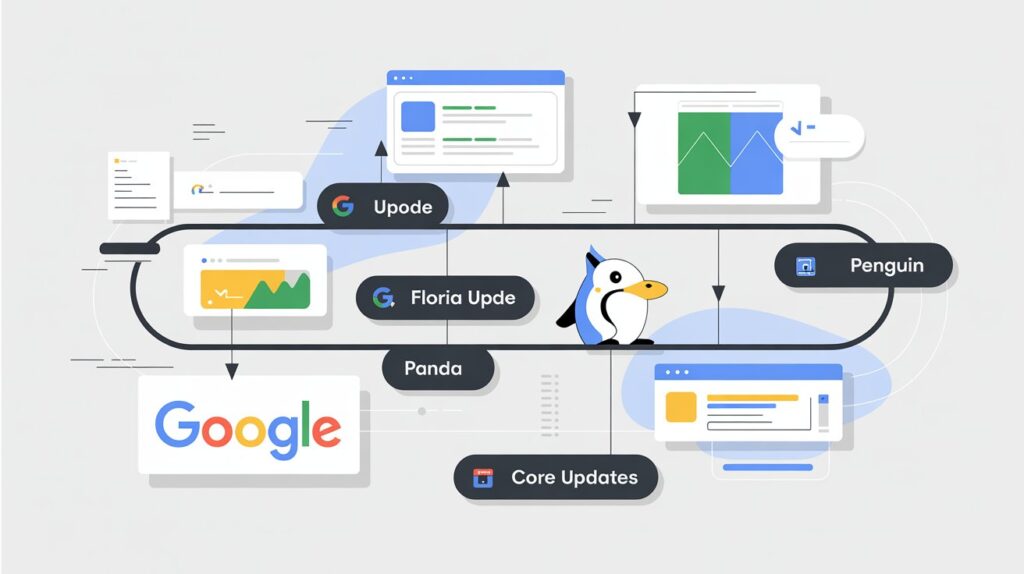
This blog explores the journey of Google algorithms, starting from the famous Florida update to the latest Core Updates and AI-driven search systems.
What is a Google Algorithm?
A Google algorithm is a complex system used by Google to retrieve information from its search index and rank webpages based on relevance and quality.
Hundreds of ranking factors are taken into account by the algorithm, including:
1.Content quality
2.Keywords
3.Website speed
4.Mobile friendliness
5.Backlinks
6.User experience
7.Page authority
8.Search intent
Google’s main goal is simple: provide users with the best possible answers for their searches.
Florida Update (2003) – The Beginning of Modern SEO
The Florida Update was one of the first major algorithm changes introduced by Google in 2003. Before this update, many websites used manipulative SEO tactics like keyword stuffing, hidden text, and spammy backlinks to rank higher.
Florida changed the SEO industry completely. Google began penalizing websites that employed unethical SEO strategies. . Many businesses lost their rankings overnight because they depended heavily on spammy methods.
This update taught website owners that long-term SEO success depends on quality content and ethical optimization rather than shortcuts.
Panda Update (2011) – Quality Content Matters
In 2011, Google launched the Panda Update to fight low-quality content. At that time, many websites published short, duplicated, or poorly written articles just to attract traffic.
Panda targeted:
1.Duplicate content
2.Thin content
3.Content farms
4.Keyword stuffing
5.Poor-quality pages
Websites with useful, original, and informative content benefited from Panda, while low-quality sites experienced ranking drops.
This update made content quality one of the most important parts of SEO.
Penguin Update (2012) – Ending Link Spam
The Penguin Update focused on backlink quality. Earlier, websites often purchased backlinks or participated in link schemes to manipulate rankings.
Google introduced Penguin to penalize:
1.Spammy backlinks
2.Paid links
3.Link exchanges
4.Over-optimized anchor text
After Penguin, SEO professionals shifted toward natural link-building strategies and high-quality content marketing.
Hummingbird Update (2013) – Understanding Search Intent
Hummingbird was a revolutionary update because it helped Google understand the meaning behind search queries rather than matching exact keywords only.
For example, if someone searched “best coffee shop near me,” Google could understand the user’s intent and provide local café results instead of pages simply repeating the same phrase.
This update improved conversational search and became especially useful with the growth of voice search.
Pigeon Update (2014) – Improving Local Search
The Pigeon Update improved local SEO results. Google began focusing more on location-based searches and local business relevance.
Factors such as:
1.Business location
2.Customer reviews
3.Local listings
4.Distance from the user
became more important after this update.
Local businesses like cafés, salons, restaurants, and stores greatly benefited from strong local SEO practices.
Mobile-Friendly Update (2015)
As smartphone usage increased rapidly, Google introduced the Mobile-Friendly Update, also known as “Mobilegeddon.”
Websites that were not mobile responsive experienced ranking drops. Google prioritized websites that offered:
1.Faster loading speed
2.Responsive design
3.Better mobile usability
4.Easy navigation
Businesses were urged by this upgrade to make their websites mobile-friendly.
RankBrain (2015) – Artificial Intelligence Enters Search
RankBrain introduced machine learning into Google Search. It became one of Google’s most important ranking factors.
In order to provide better results, RankBrain analyzes user activity and helps Google comprehend new or complicated search queries.
It focuses on:
1.Search intent
2.User satisfaction
3.Click-through rates
4.Engagement signals
This update emphasized how crucial it is to produce content that genuinely fulfills users.
BERT Update (2019) – Better Language Understanding
BERT (Bidirectional Encoder Representations from Transformers) improved Google’s ability to understand natural language and conversational searches.
Earlier, Google sometimes misunderstood the meaning of long or complex queries. BERT helped the search engine understand context, sentence structure, and relationships between words.
Instead of filling material with keywords in an unnatural way, this upgrade encouraged content authors to write naturally and concentrate on readability.
Core Web Vitals Update (2021)
Google introduced Core Web Vitals within its Page Experience Update to improve website user experience and performance. This update focused heavily on website performance and user experience.
Core Web Vitals measure:
1.Loading speed
2.Interactivity
3.Visual stability
Websites that loaded quickly and provided smooth user experiences gained ranking advantages.
This update showed that technical SEO and user experience are equally important alongside quality content.
Helpful Content Update (2022)
The Helpful Content Update sought to decrease content produced primarily for search engine rankings and reward content that prioritizes humans.
Google targeted websites producing articles that lacked originality or real value.
This update encouraged creators to:
1.Share expertise
2.Provide useful information
3.Write naturally
4.Focus on user needs
Authenticity and human-centered writing became more important than ever.
Google Core Updates -The Current SEO Reality
Today, Google frequently releases Broad Core Updates, commonly known as Core Updates. These updates are not focused on a single issue like backlinks or mobile friendliness. Rather, they enhance Google’s total capacity to assess the quality and applicability of content.
Core Updates usually affect:
1.Content relevance
2.Expertise and authority
3.User trust
4.Search intent satisfaction
5.Overall website quality
Google now emphasizes E-E-A-T:
1.Experience
2.Expertise
3.Authoritativeness
4.Trustworthiness
Websites that demonstrate real experience, accurate information, and strong credibility perform better after Core Updates.
AI and the Future of Google Search
Google is now entering an AI-powered search era. With AI systems and advanced machine learning, search results are becoming more personalized and intelligent.
Algorithm manipulation is no longer the focus of modern SEO. These days, success depends on:Creating valuable content
Understanding audience needs
Providing excellent user experience
Building trust and credibility
Businesses and marketers who focus on helping users genuinely will continue to succeed in the future.
Conclusion
The journey of Google algorithms from Florida to today’s Core Updates reflects Google’s mission to improve search quality continuously. Each update has pushed websites toward better content, ethical SEO practices, and improved user experiences.
From Panda’s focus on content quality to Penguin’s crackdown on spammy backlinks and today’s AI-driven Core Updates, one thing remains clear: Google rewards websites that provide real value to users.
For digital marketers, bloggers, and businesses, the best SEO strategy is no longer about tricks or shortcuts. It is about creating trustworthy, informative, and human-focused content that genuinely helps people.